Making the Film
Craft, improvisation, and collective effort
Filming was a big task of coordination. There were dozens of actors, multiple camera positions, sound recording issues with nearby traffic, period clothing to ensure was authentic and complete, and weapons safety concerns. There were special effects, makeup, meals, transportation, weather planning. People and equipment had to be moved across wooded terrain.
Reenactors brought more than costumes. They brought practical knowledge: — how 1860s clothing is worn
— how equipment hangs from the body
— how a musket is carried
— how a formation of soldiers moves
With the 1860s in front of the camera, behind the camera was fully 21st Century — digital cameras, monitors, microphones, batteries, iphones, cold canned beverages.
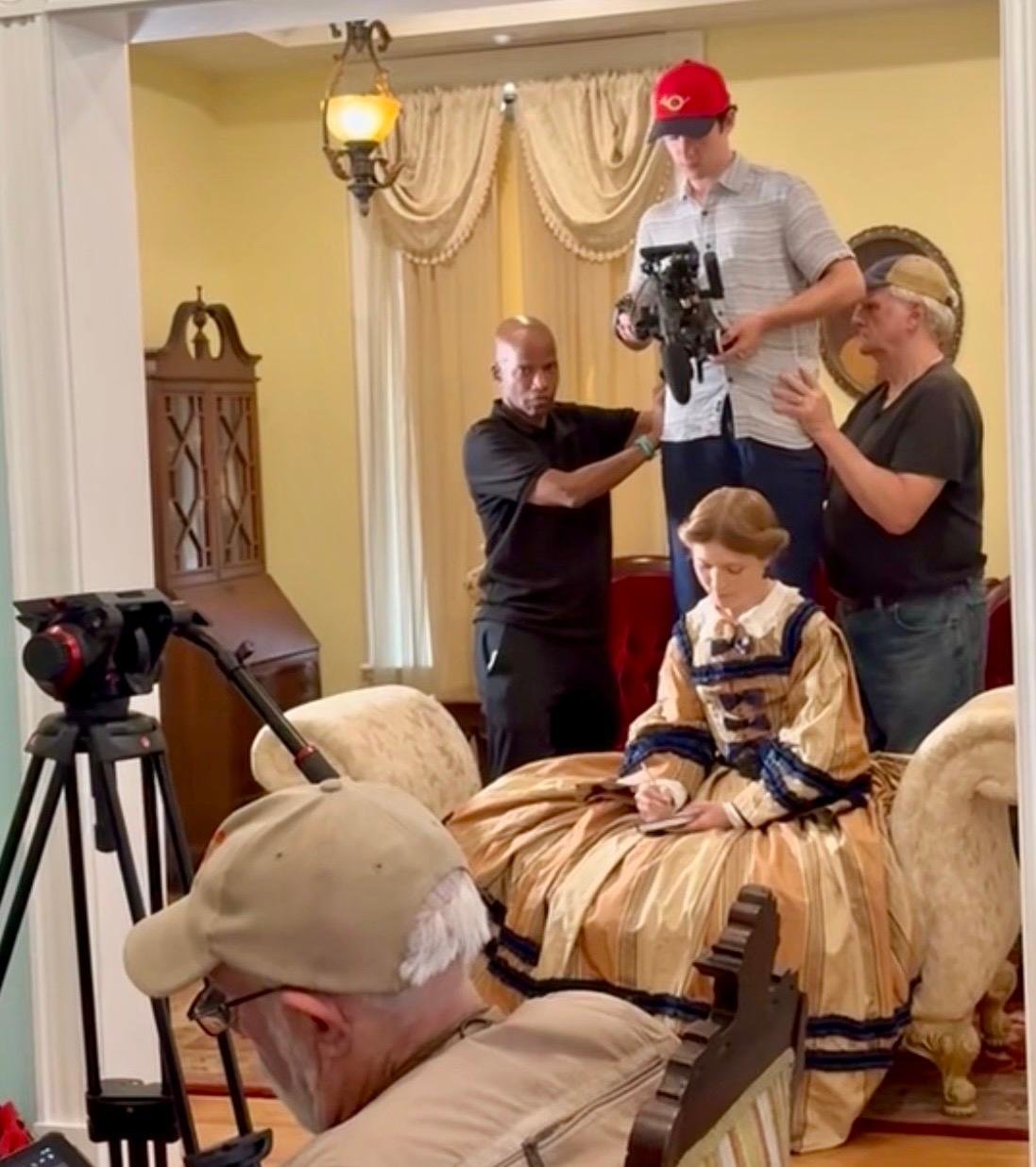
Getting the Shot: Improvisation at Langdon Hill House
Small productions sometimes solve camera and other problems with whatever is immediately available. At Langdon Hill House, Jacob needed camera positions for which he did not have sophisticated scaffolding or other means to achieve. People became part of the camera support. Here, George E. Edwards & Brad Graham propped up Jacob who stood on a shaky chair attempting to capture a shot.
Six days, two weekends, and a final Monday
Principal photography created fragments rather than a continuous story. The first weekend concentrated on battlefield, camp, headquarters, and exterior military scenes at Monterey Pass. The later period moved into the Lincoln Train Museum, Langdon Hill House, and smaller dramatic scenes before filming ended on Monday, 3 August 2026.
Outdoors, the crew worked around heat, insects, wind, shifting sunlight, drifting smoke, motorcycles, a nearby chain saw, and helicopters associated with Camp David. Indoors, the production worked around narrow rooms, historic surfaces, modern switches, reflective objects, and limited camera positions.
Life at camp after the cameras stopped
A dozen tents, which were part of the set where filming occurred, formed an encampment where Union and Confederate reenactors slept for multiple nights during filming. The camp was not merely scenery — it reflected a living-history community that studies event calendars, travels to commemorations, maintains unit networks, buys and trades specialized equipment, cooks, sings, discusses campaigns, and preserves military routines through repeated practice. And, it reflected camaraderie, kinship, and fun.
Casting notices circulated by participants such as Greg Hale and Michael Courter sought “authentic living historians,” requested photographs showing applicants in the historical roles they regularly portrayed, invited reenacting-unit organizers to make direct contact, and emphasized historically accurate detail. This resulted in experienced participants whose knowledge of drill, camp routine, uniforms, weapons, and field movement became one of the production’s principal resources.
Living history, clothing, equipment, and field practice.
Many reenactors own period clothing and equipment. Some make their own garments. Some participate in reenactments, parades, commemorations, and public-history events as well as film work..
Directing at age nineteen
Jacob was responsible for converting an ambitious idea into a functioning production. That meant creative decisions, but also safety, scheduling, communication, technical coordination, and the authority to ask experienced adults to execute a nineteen-year-old director’s vision.
His conversations with performers, camera personnel, reenactors, and the pyrotechnics specialist show the less visible side of directing: asking questions, listening, weighing risks, and turning specialized knowledge into a coherent scene.